this time it's really happening here, Mr Jones!
Do you know yet what it is ?
it's the people's media and it can change the people's world:
seize control of the media -
they do not belong to the corporations
So do we live with the web as a fantastically broad and socially cohesive catalogue of facts and information or is it a graphic, poetic and animated on-line experience?
Hypermedia have been foreseen and discussed for some time - the innovators
have innovated and we're just approaching the crest of the wave. The
steep bit of the learning curve is achieved and we can get on with understanding
and applying the media.
CD ROM was a key breakthrough - at least while the net was a slow and baby beast. But it was still steeped in past perceptions of publishing as a one way monologue. Same with e-books and interactive movies where the author thinks up as many plot ressolutions as possible and films them all - and the viewer has to tick-box pick from predetermined choices. this is not true interactivity.
Paolo Freire was the great South American educator who turned against top down schoolroom education - banking education - in favour of teaching and learing based on dialogue. If he had had the use of hypermedia, his writings would not have fallen into the top down trap where any paper book resides, where statements are embalmed for all time. Soft copy, as opposed to hard, allows interaction and dialogue.
Just as the horseless carriage mimiced an old technology, the CD ROM imitates the publlished book. Even with internet hookup it can't be as flexible as an open, broad-bandwith, web experience.
 So
now we have to create the medium - discover its unique qualities, develop
its characteristics, exploit Eisenstein's
principles of montage as we set one medium side by side with another
in the same matrix. With interactive digital TV, the telly is fast
becoming a computer that you look at from the sofa. Eventually there
will be a home network, with telly, telephone, net and hypermedia all linking
to the virtual/real world outside. It will be our in-house couch-potato
link to the noosphere.
So
now we have to create the medium - discover its unique qualities, develop
its characteristics, exploit Eisenstein's
principles of montage as we set one medium side by side with another
in the same matrix. With interactive digital TV, the telly is fast
becoming a computer that you look at from the sofa. Eventually there
will be a home network, with telly, telephone, net and hypermedia all linking
to the virtual/real world outside. It will be our in-house couch-potato
link to the noosphere.
Unlike today it will be a medium of choice - and what people will watch can only depend on what the want. If it's not there, they will create it. In hypermedia the tools of creation are much the same as the tools of interpretation. That's why exchange is possible, dialogue. The web is alive, it will evolve according to the sum of its parts.
But not just yet. WE have to make it happen.
If hypermedia in general are to hold their own then they must evolve a unique identity , they must be able to offer an experience that is distinct from other media, whether taken separately or galleried together.
web 2.0 ....
Old style hard copy publishing (whether it's a book or a CD or even a DVD)
communicates TO or even AT the visitors.
With genuine two way communication, with a growing organic community of knowledge
- only everyone can know the truth (Goethe) - comes a cultural shift.
IF we don't go and leave the developing economies behind again we could just
end up with an egalitarian society (shut up, you old hippy) if we have made
the rules ourselves.
The power base will shift in a cyberspace world and a cyber-organisation. But there are many who will try to stop this. All the corporate intranets of the world will be branded and templated and constrained to resist the imagination at all costs. Nothing is new - but we should see it coming.
Many of web 2.0's celebrated applications - google for example, e-bay, amazon - work on advdertising. the bedst of them, like google, depend on the traffic and make their ads discrete and 'smart'.
altered modalities of think,
and our kids are educating us
(when we choose to look)
As the brain works associatively, so does the web. Vannevar Bush knew that when he came up with his memex machine back in 1945. Our linear minds are trained to read and think in a straight line of logic. Most books are written that way. Academics at our universities and institutions that shape our patterns write and deliver lectures that way.
Some cultures never bothered to go that way; they didn't get into printed books - remaining with oral transmission of knowledge using mythical forms. Another kind of truth and a very different logic. Aid workers and development agents become frustrated - even some with anthropologists' training - when the logic of cause and effect is not an available resource among those they seek to support. They put it down to lack of education. which of course it is, but the assumption is that lack of (a certain type of) education is raw ignorance. The people themselves get to believe it and put down their own rural folk as ignorant. "You know, you can always begin anywhere." --John Cage
The web and hypermedia, if we allow them to realise their potential as the new currency of communication, could be the great equaliser. The interactive process allows new forms, structures and cultures of thought and communication to emerge.
There are many who know this, but Mr Jones now appears to know something is happening and and there are many who resist the trend. WSIS came up with no real resolutions to fund the basic bricks (sorry, bytes) in the bridge across the so-called digital divide. The race is on.
But the web will change all that. (damn hippy again - but look at Leary, he gave up acid for this).
the five modalities of newthink - bathing in the noosphere
- associative linking of information (throw away the card index)
- Imagine the possibilities = 'what if' simulations.
Try it and see. - visual, audio, kinaesthetic, cerebral and verbal means
of communication all together
everybody's learning style catered for - semantic compression - sound-bites and semiotics
(nudge nudge wink iconography, buttons as the lateral leap) - thinking as one - working as a collaborative society
(ever heard of grid computing - it's happening now)
the web is - and we can begin to name our world.
it's part of the membrane of mind that is our networked world. It plugs us into all the computers of the world. It interacts through our telecommunications and reaches any where at all - especially if you include the hackers hacking through the undergrowth as it grows up around us.
And it finally rids us of the beginning middle end narrative strait-jacket. Stories are told from back to front, inside out and now sideways too. A story is a river, said Ben Okri, you can start or stop your story wherever you want, it will flow on without you. Now you can follow tributaries and allow others to dam them, open them, sail away into the sunset on them. We can name our world as Paolo Freire urged us to do, in seizing power and making the world work FOR us all,
But don't get me wrong - there's nothing wrong with words. It's just that the web allows dialogue, and academic articles are never participatory - even if the author is Paolo Freire.
So if one of the strengths of the web is dialogical publishing -- let's settle for the word communication. Assuming that we understand communication as a two-way process, a dialogue.
So now you can make a film and not only show it TO the audience, you really can share it with them. Jean-Luc Godard was only half right when he said the important part of a film was what happens in between the screen and the audience. Now it's also what happens between the audience and the screen and all the way back to the film-maker.
Ted Nelson's idea of hypermedia was that all knowledge would be connected and ubiquitous. It will be the basis of all telecommunications - with the telephone just a part of it where up to now the net has been part of the telephone service. This is more powerful than acid, Leary said. It will surely change our way of life.
And then there's thinking! Now hoarding knowledge is counter-productive. There is so much relevant info that organisations cannot afford to play cards so close the their chests - a knowledge hierarchy is too slow, they can't keep up and be 'competitive'. (How has the word competitive come to mean 'equal')
. The rulers of the world have always relied on their secrets (their ownership of information and knowledge that should belong to all of us) to ensure their power-base. A shift in ownership of knowledge will affect that power-base. Seize the media - they are ours. With the web, the truth will out, even the secrets of the powerful are no longer watertight (watergate??).
The web can provide a redistribution of knowledge and power. As a shared commodity, perhaps that can even start the snowball of redistribution of wealth. LOng live the hackers of open source. This is the political dimension. The hackers are guerilla fighters with a bad name.
If it's a membrane of mind, of thought, we must be developing new thought patterns, new ways to handle and process our new non-linear thoughts, narratives and processes. And if we want to talk to the new people, we need the new language, born out of newthink. And Mr. Jones doesn't do newthink all that well - ah , you know something is happening here, but you don't know what it is, do you, Mr Jo-ones!
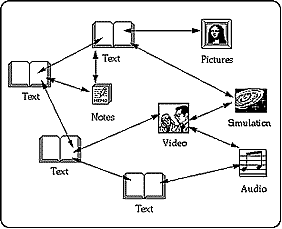
But it's not just knowledge that contributes to newthink in hypermedia. Now we can engage all sorts of different forms and senses (multiple media) - this allows the audience/reader/visitor/on-line partner (call us what you will) to engage with the material on a broad range of levels: experiential, sensory, intellectual, analytical, emotional. It can all be there in the same piece of work, the same opus. (what ARE we to call it?)
Let me start a list of interesting examples of some of this:
-
there's telecommunications -
-
there's Grid computing that virtualizes processing and storage resources and lets people use, or rent, the capacity they need for particular tasks. So a university in Canada can make their library available on-line to a university in Kenya, and to all the world for that matter.
Or the ge-nome project which needed unheard of calculating capacity - so they invited net-people (??) to lend their computers to the project, when they would otherwise have been off-line or in bed. While their humans slept, thousands of computers calculated the details of DNA, reporting back to big brother. Yes, there are sinister potentials too - unless we seize the media for ourselves.
Right now you can joint the climate prediction experiment developed to allow a state-of-the-art climate prediction model to be run on home/ school/ work computers. By getting data from thousands of climate models, we will generate the world's largest climate prediction experiment.
-
there are pubs full of people gathering to watch the world cup football played on another continent - reinventing the local neighbourhood community even as they cheer - and all that simultaneously with people all over the global village looking at the same game at the same time as it is being played.
-
there are all manner of web cast live simultaneous performances - people acting in the same event at the same time but the actors are both in Japan and at the Riverside studios at the same time. (In due course I'll add some links here.)
-
there was Band Aid, watched by all the world at once. There was the millennium turnaround where we saw the century changing over in Kiribati half a day before it changed over here.
-
and there was the massive protest all around the world against the irrevocable (as it turned out) invasion of Iraq. (and those secrets are out now too ...)
-
and there are people playing the Simms family (simulations, what ifs) anywhere from here to Kiribati, web-live, on-line, on the web even as we speak (you can tell ME about the others ... moki town, habbo hotel, runescape, coke studios ... )
- and now there's web 2.0 (check out the last part of the links page)
| home | future | history | what is it? | net4dev | links |