key figures and what they did
initial info here is drawn from Understanding
Hypermedia by Bob Cotton and Richard Oliver (Phaidon press 1997).
By the way it also contains an impressive timeline of media developments and
"A brief history of hypermedia" (Chapter 11 -- MEDIA FUSION)
Roughly, this is the path they chart:
from telegraph and telephone, with morse code invented by artist Samuel Morse we got communications thru virtual contact. We got the cinema, bridging the real and a virtual worlds. There was radio, and then there was Television which was something like the radio plus pictures,
-- with the power to turn it on or off at will, and because its poor resolution required the participation of our own brains to turn a bunch of lines per second into actual moving images, it is a cool medium in McLuhan's terms. It allows us to process the content as we digest it -- and it brings the news, and the world, into our homes. Raw information is digested and can be interpreted, considered and acted upon. That is how information becomes knowledge.
(Media like radio or film, with its higher resolution, feed images and information directly into our minds - more successful for use as advertising and propaganda). Cool media, including hypermedia , are more condusive to true understanding and dialogical exchanges.
Hypermedia, according to Cotton and Oliver, " integrated radio, film, theatre, dime novels, magazine, advertising hoarding, comic strips and newspaper, providing a multiple-media magazine of all these ..." (Hypermedia 2000)
computersComputers allowed the fusion of all these-- represented (By
Negroponte, dir MIT Medialab) as a venn diagram - with overlapping and mutually
useful qualities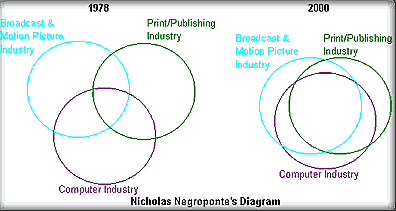
.."You would pull the audiovisual richness out of the broadcast-entertainment ring. You would pull the depth of knowledge and information out of the publishing ring. And you would take the intrinsic interactivity of computers and put these three things together to get the sensory, rich, deep, interactive systems that today we call multimedia. That idea made sense 20 years ago when the three rings were our marketing symbol, and even today it's a good way of summarizing what we do." (Negroponte, Interview in Wired Magasine)
It was the shift from analogue to digital that enabled different types of media to start moving together - types that were physically, aesthetically and functionally different. Now they are all reduced, via binary digits, to one format and then back out again ...
Medium and Message begin to converge
Negroponte: " we need to be thinking of bits not atoms" .. .. .. "the value of intellectual and creative property lies in its content not in its physical form" .
CD-ROM
- designing the future through the rear viuew mirror (a McLuhan idea) -
Could turn out to be an interim format, for storage and portability. CD-ROMs are a bit like paper (hard copy) books, an old technology publishing format. Of course some CDs now bridge that gap and contain links which take you right out into the net again.
Likewise where some books, especially computer books of course, have begun to carry a CD-ROM with the same and additional information, now others have gone further and maintain a website fdor the same information as well as errata and, who knows, maybe some hypermedia content too .....
Internet
It's a communications network drawing from all the media, that must and will develop its own uniqueness -- - with hypermedia content available to all publishing may never be the same again.
Think of all the problems of ownership and piracy, of the music moguls, of knowledge and today's leakages of official secrecy. Internet as a medium promotes open source and free access - even if our leaders resist this. It's worth noting also the inability of the recent WSIS world information summit to arrive at any real resolution to subsidise the development if information technology in the developing economies. WE are about to make the same mistake again and abort the global village just when it is being born, it's busy dying.
Check out the one world TV people's video coverage of the WSIS conference. some links to the official accounts of the conference: (www.itu.int/wsis/), www.wsis-cs.org/ , www.wsis-online.net/ and www.oneworld.net/
some cd started to be interactive with links direct to net so best of both. Examples of these are cited in HM 2000.
And for a fuller account of hypermedia history, look at the timelines and diagram in Hypermedia 2000. Or visit the BBC . which offers its own historical perspective. From ARPA (USA defense ) to academic research and out into the world - and still ARPA is there, it's now called DARPA and it's still sinister ....
and today we get to the mysterious, elusive, sharing, web 2.0 of today ...
And these were some of the key innovators:
1945 - Vannevar Bush,
who came up with the idea of associative links and his Memex
System (looked a bit like a Steenbeck film editing desk). Multimedia
machine, based in ideas of microfilm files) conceived 40 years before Apple
came up with the Hypercard (and later MacroMedia with Director etc.)
The human mind works by association and interconnections, not linear logic.
He spoke of encyclopaedias based on trails of associative links. Contemporary infgormation is too much and too conplex for the old systems, so he sought to store information in blocks (later = packets) with associative links to related material. Today we have breadcrumbs to mark the trail...
Early 60s - Douglas Engelbart
and the "augmentation of the human intellect"
- mouse, multiple windows, e-mail and hypertext: marriage of human skills
to organise and make choices and computer mechanics. He brought
in the first notions of computers as medium of communication -- information
traveling through an information space ....
(currently working with Sun Microsystems)
1965 - Ted Nelson the visionary maverick.
We've gone wrong already and noone is listening to Ted!
His project XANADU decries, to this day,
the one way dialogue and shallow www. Check out the Xanadu
model ... the vision is still alive. He thought it all thru in the
sixties and seventies -current hypertext is shallow - it should be a two way
communication, links should not be so fragile -
newer versions of code for the the now classic Xanadu Model is currently being developed by David Durand
Ted Nelson's Cosmic Book is a set of pages with visible connections: a project currently run from Southampton by Ian Heath at RunLevel3.
his book Computer Lib: Dream Machines is now a collector's piece.
hypermedia - it's Ted's term - a two way read/write medium available
to everyone; a "media form that utilised the power of computers
to store, retrieve and display information in the form of pictures, text,
animations and sound." , Already used the term hyper- to
indicate cross-reference, or jumping: so in hypertext, textual material could
be inter-linked. This "provided a system which would break down
traditional subject classifications and allow non-computer literate users
to follow their own lines of enquiry across the whole field of knowledge."
"Writers could then include ANY level of detail, and allow the reader
to decide how deep into the subject matter they wanted to go".
"Creating successful hypermedia depends on applying the arts of communication design to both content and structure ...." But you don't have to know how to code (a poet doesn't need to be a touch typist )
Xanadu project (still alive) is to link all knowledge - in text, video, etc - and to make it available to all. Open access.
1968 - Alan Kay and his dynabook.
portable personal computer using a graphical user interface (- GUI -
a screen! with windows, bitmapped screens, icons and the mouse) and linking
by phone and wireless to other computers.
Addition of graphic potential (paintbrush) and intended as educational tool for children. Capacity to handle text led Kay to claim that this would finish off the Gutenberg revolution.
Worked with Xerox on the above, works now for disney, though also renowned for his insistence on the potential of computers to be used to improve the human condition - especially in its capacity for learning. Aim to create better learning environments.
1984 - Bill Atkinson really added the user-friendly
touch,
with Mac Paint and in 1987 the HYPERCARD which, like the Memex, a product
of a vision in advance of available technology. So Hypercard superceded
in due course by Director etc. Nevertheless its ease of use started
a democratisation of computer usage - "moving computers away from being
a technical tool for media specialists into being a general purpose communications
medium designed to be used by everyone."
1991 - Sir Tim Berners-Lee
Placed his www programmer onto the internet for open access. He was working
for CERN (European centre of Physicists - all working in different institutions)
Initially it was so that the three nm ain internet users (who needed otherwise
to have the same software) could communicate usefully and fast.
And the key to this was the URL ((Uniform Resource Locator -- unique address for every user), HTTP (Hypertext Transfer Protocol software standards allowing communication between different kinds of computer), HTML (Hypertext markup language - specifying how text will look in a browser window).
an interactive sea of shared knowledge.
Berners Lee now works for the W3 Consortium at MIT. And he just got given a knighthood over here in Britain!
Cotton and Oliver go so far as to equate his revolution with that of Gutenberg and the development of his printing press.
1992/3 - Marc Andreesen
came up with Mosaic - the first user-friendly browser. Led to Netscape
Navigator
And the visionary fathers:
McLuhan, Fuller,
Gibson, Rushkoff
..... Teilhard
de Chardin
welcome to the 21st century.
Marshall McLuhan
whose idea of a global village brought on by our entry into the 'electronic
age' was way ahead of his time. He too imputed huge significance, including
the development of individualism, to the gutenberg revolution (see his book
the Gutenberg Galaxy) and his 'The Medium is the Massage' was a book laid
out with graphics that itself was a precursor to our 'mosaic' (his term) style
of graphic/screen representations today. Out with linear narrative,
in with associative and packeted connections.
William Gibson
known today more for his 'Matrix' (from his seminal cyber punk trilogy,
The 'Neuromancer') where he coined the term cyberspace (see p 38) as a global
telecommunications network.
Douglas Rushkoff
pointed out that "we have traveled further than any generation in history"
- bombarded by ideas incl TV, relativity, quantum theory, string theories,
big bangs and fuzzy logic. He points to our children maintaining that we should
be learning from them.
Author of 'Children of Chaos' and 'Cyberia': He believes that we are creating a new generation of 'screenagers' who are more open minded and flexible than their programmable parents. I wonder ....
Timothy Leary
In his book "Chaos
and Cyberculture", Leary asserts that our collective mind may have
a parallel effect on our collective mind as his trumpeted acid revolution.
"The PC is the LSD of the Nineties."
-- Timothy Leary
"Every time you think he's senile, he's not."
-- Winona Ryder, Leary's god-daughter, in "Life" magazine
In "Chaos," Leary examines digital technology's effects on chaos theory with the help of William Gibson, David Byrne, William S. Burroughs, and others, with a good measure of new-age metaphysics on the side.
As humans further develop their psychological capabilities, Leary says, they
become ever-closer to "forming neural-electronic symbiotic linkups with
solid-state computers." These linkups, Leary believes, will cause us
to operate at higher levels of intelligence - "mapping and colonizing
the next frontier - one's own brain," and "protecting [it] from
invasion and exploitation from without."
John Perry Barlow
(Grateful Dead lyricist and founder of the Electronic
Frontier Foundation)
fights for digital freedom and a new age of open shared information and knowledge.
Before you go:
Just don't forget - that the neoliberal forces of globalisation are pitted against all this, hoping to turn the net into a virtual shopping mall - but the dot coms didn't crash by accident. It may be counter to the spirit of the thing.
Bob Cotton, is a
new media analyst and creative developments director of Edutainment Centres,
an agency specialising in e-business consultancy, training, and media marketing
design, based in the Isle of Wight. He is also external examiner of the MA
in Communications Design at Central St Martins and new media design courses
at the University of West England and Bournemouth University.
His previous books include:
UNDERSTANDING HYPERMEDIA (Phaidon, 1993) THE CYBERSPACE LEXICON (Phaidon,
1994) UNDERSTANDING MEDIA 2000 (Phaidon, 1998) YOU AIN’T SEEN
| home | future | history | what is it? | net4dev | links |